
If you’re running a business in Australia and searching for virtual assistant cost in Australia information, you’ve come to the right place. Virtual assistant costs in Australia vary significantly, but understanding the pricing landscape can save your business thousands of dollars annually. Virtual assistants have become a game-changer for Australian businesses looking to cut costs while keeping productivity high. Whether you’re a small startup in Melbourne or an established company in Sydney, understanding virtual assistant cost Australia can help you make smart decisions for your business.
Virtual Assistant Cost Australia: What You’ll Pay
The cost of hiring a virtual assistant in Australia varies quite a bit, but here’s what you can expect to pay when researching virtual assistant cost Australia. Most virtual assistants charge between $8 and $80 per hour, depending on their skills and experience. The sweet spot for many Australian businesses is around $15 to $35 per hour for quality work.
If you’re looking for basic administrative tasks like email management or data entry, you’ll typically pay between $8 and $20 per hour. For more complex work like marketing support or customer service, expect to pay $15 to $35 per hour. Specialist services such as bookkeeping, web development, or advanced marketing can cost anywhere from $35 to $80 per hour.
The beauty of virtual assistant pricing is its transparency. Unlike hiring full-time employees, what you see is what you pay. There are no hidden costs for superannuation, office space, or equipment.

Why Virtual Assistant Pricing Australia Varies So Much
Several factors influence how much you’ll pay for a virtual assistant in Australia. Understanding these can help you find the right balance between cost and quality for your business needs.
Experience plays a huge role in pricing. A virtual assistant who’s just starting out might charge $8 to $15 per hour, while someone with several years of experience could charge $25 to $50 per hour. The difference often shows in the quality of work and how quickly they can complete tasks without needing guidance.
The type of work you need done also affects pricing significantly. Simple administrative tasks are generally the cheapest option. If you need someone to manage your emails, schedule appointments, or do basic data entry, you’re looking at the lower end of the price range. More complex tasks like social media management, content creation, or technical support will cost more because they require specialised skills.
Location matters too, though perhaps not as much as you might think. Australian-based virtual assistants typically charge more than their overseas counterparts, but you get the advantage of working in the same timezone with someone who understands local business practices and regulations.
Comparing Different Pricing Models
Virtual assistants in Australia typically offer several different pricing structures, and choosing the right one can save you money while getting better service.
Hourly rates are the most common pricing model. This works well if you have irregular workloads or want to test out a virtual assistant before committing to larger projects. Most hourly rates range from $8 for basic tasks up to $80 for highly specialised work.
Package deals often provide better value for money. Many virtual assistant services offer blocks of hours at discounted rates. For example, you might pay $250 for 20 hours of work instead of the regular $300 you’d pay at $15 per hour. These packages typically need to be used within a set timeframe, usually 12 months.
Monthly retainers work well for ongoing relationships. If you know you’ll need consistent support, a monthly arrangement often costs less than paying hourly rates. You might pay $800 to $1,500 per month for part-time support, or $1,500 to $3,000 for full-time equivalent hours.
The Real Cost Comparison with Full-Time Employees
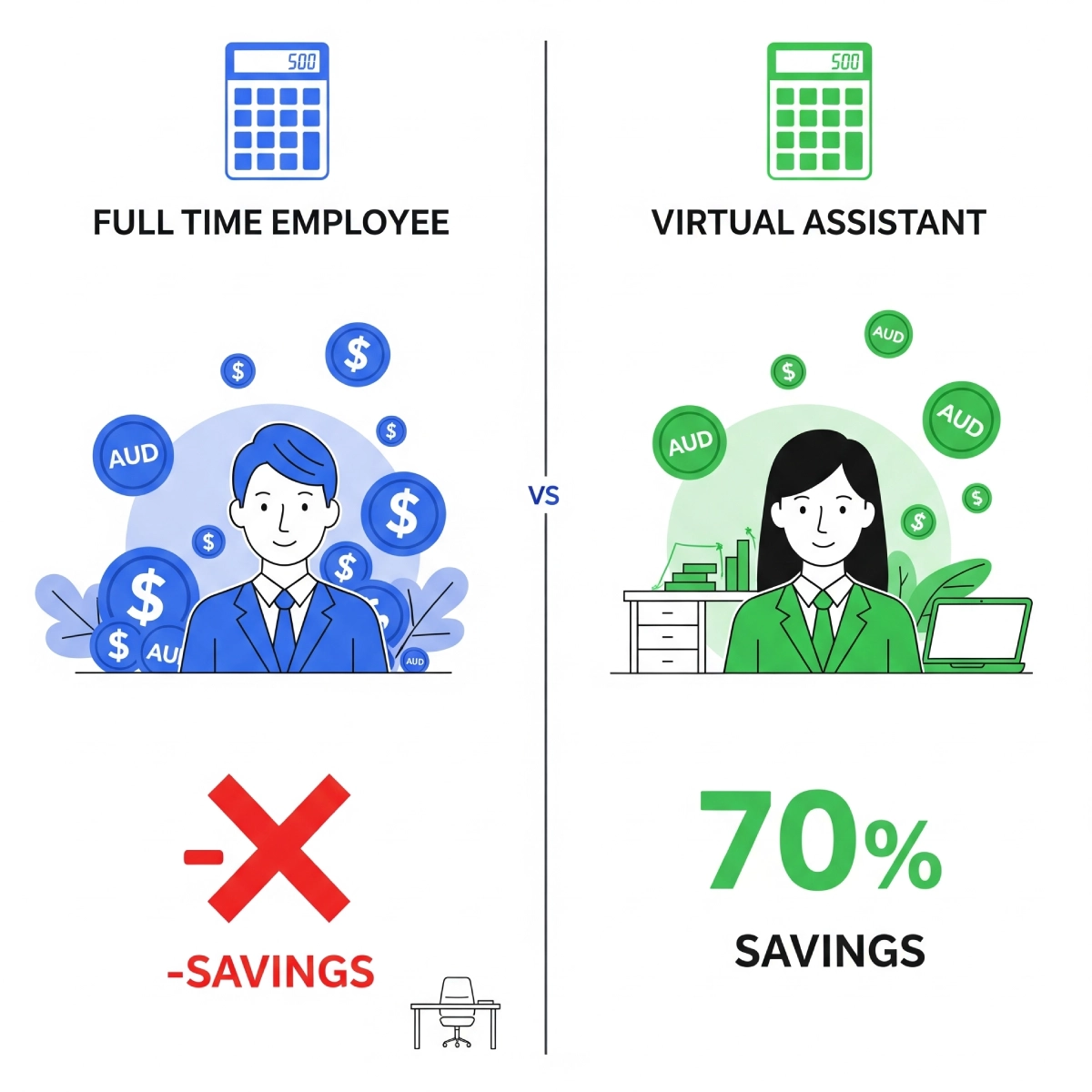
When comparing the cost of a virtual assistant in Australia to hiring full-time employees in Australia, the savings become crystal clear. A full-time administrative employee earning $55,000 per year actually costs your business much more than their salary suggests.
Once you add superannuation contributions, annual leave, sick leave, office space, equipment, and other employment costs, that $55,000 salary becomes closer to $80,000 in real costs to your business. This doesn’t even include recruitment fees, training time, or the risk of having to pay redundancy if things don’t work out.
In contrast, a virtual assistant working full-time equivalent hours (40 hours per week) at $20 per hour would cost you around $40,000 per year with no additional costs. That’s a saving of roughly $40,000 annually, which is significant money that could be reinvested in growing your business.
Even if you only need part-time support, the savings add up quickly. Twenty hours per week of virtual assistant support at $15 per hour costs just $15,600 per year, yet provides substantial help with your workload.
What Type of Virtual Assistant Do You Need?
Different types of virtual assistants command different rates, so it’s worth understanding what you actually need before you start shopping around.
General administrative assistants are the most affordable option, typically charging $8 to $20 per hour. These virtual assistants can handle email management, appointment scheduling, basic data entry, and document preparation. They’re perfect if you need help with routine tasks that don’t require specialised knowledge.
Customer service virtual assistants usually cost $12 to $25 per hour. They can manage live chat support, handle phone calls, process orders, and deal with customer enquiries. If you run an online business or need extended customer service hours, this type of support can be invaluable.
Marketing virtual assistants typically charge $18 to $40 per hour. They can manage your social media accounts, create content, help with email marketing campaigns, and conduct market research. For many Australian businesses, marketing support provides an excellent return on investment.
Technical virtual assistants command higher rates, usually $25 to $60 per hour. They can help with website maintenance, basic programming, software support, and data analysis. While more expensive, they can save you significant money compared to hiring local technical specialists.
How to Find Quality Virtual Assistants Without Breaking the Bank
Finding a good virtual assistant at a reasonable price requires some research, but it’s definitely achievable. The key is knowing what to look for and what questions to ask.
Start by clearly defining what tasks you need help with and how many hours per week you’ll need support. This helps you communicate your needs clearly and get accurate quotes from potential virtual assistants.
Don’t automatically go for the cheapest option you find. Virtual assistants charging extremely low rates often lack experience or may not provide reliable service. Similarly, the most expensive option isn’t always the best value. Look for virtual assistants who offer fair pricing for their skill level and experience.
Ask about trial periods or money-back guarantees. Reputable virtual assistant services are confident in their quality and often offer ways for you to test their service risk-free. This is particularly important when you’re working with someone new.
Check reviews and ask for references. Good virtual assistants will have positive feedback from other Australian businesses. Don’t be afraid to ask questions about their experience, communication style, and availability.
Managing Costs and Getting the Best Value
Once you’ve found a virtual assistant, there are several ways to keep costs under control while maximising the value you receive.
Clear communication is essential for cost control. The more specific you can be about what you need, the more efficiently your virtual assistant can work. Vague instructions often lead to revisions and extra time, which increases costs.
Start small and build the relationship gradually. It’s better to begin with a few hours per week and increase as you build confidence in the working relationship. This approach helps you avoid overpaying for services you might not need.
Batch similar tasks together. If you need multiple documents formatted or several research tasks completed, giving them to your virtual assistant all at once is usually more efficient than spreading them out over several sessions.
Be realistic about timelines. Rushing jobs often incurs premium rates. If you can plan ahead and give reasonable deadlines, you’ll typically get better rates and higher quality work.
Red Flags to Watch Out For
While most virtual assistant services are legitimate, there are some warning signs that might indicate you’re not getting good value for money.
Be cautious of extremely low rates, particularly anything under $5 per hour. These rates often indicate poor quality work, high turnover, or hidden costs that will emerge later. Remember, you generally get what you pay for.
Avoid services that demand large upfront payments without offering trial periods. Reputable virtual assistant services are confident in their quality and don’t need to lock you into long-term commitments before proving their worth.
Watch out for unclear pricing structures or services that can’t clearly explain what’s included in their rates. Good virtual assistant services are transparent about their costs and what you can expect for your money.
Making the Most of Your Virtual Assistant Investment
To get the best return on your virtual assistant investment, think strategically about how you use their time. Focus on tasks that free up your time for activities that directly generate revenue for your business.
Virtual assistants are particularly valuable for repetitive, time-consuming tasks that don’t require your specific expertise. Email management, appointment scheduling, data entry, and basic research are perfect examples of work that can be delegated effectively.
Consider the learning curve when assigning new tasks. While it might take a few sessions for your virtual assistant to master new processes, the long-term efficiency gains usually justify the initial time investment.
Track the results and adjust as needed. Pay attention to how much time you’re saving and whether the quality meets your standards. Good virtual assistants should become more efficient over time as they learn your preferences and processes.
Getting Started with Virtual Assistant Services
If you’re ready to try virtual assistant services, start with a small project to test the waters. Most Australian businesses find that 10 to 20 hours per month is a good starting point that provides meaningful help without a huge financial commitment. You can explore professional virtual assistant services that offer transparent pricing and quality Australian support.
Be prepared to invest some time upfront in training and setting up processes. While this requires initial effort, it pays off quickly when your virtual assistant becomes familiar with your business and can work more independently.
Consider your timezone needs when choosing a virtual assistant. If you need real-time support during Australian business hours, local or nearby timezone virtual assistants might be worth the extra cost. For tasks that don’t require immediate turnaround, offshore virtual assistants can provide excellent value.
Virtual assistant cost in Australia offers excellent value for money compared to traditional employment. With rates starting from just $8 per hour and the flexibility to scale up or down as needed, virtual assistants provide a cost-effective solution for businesses of all sizes. The key is finding the right balance between cost and quality that works for your specific business needs.